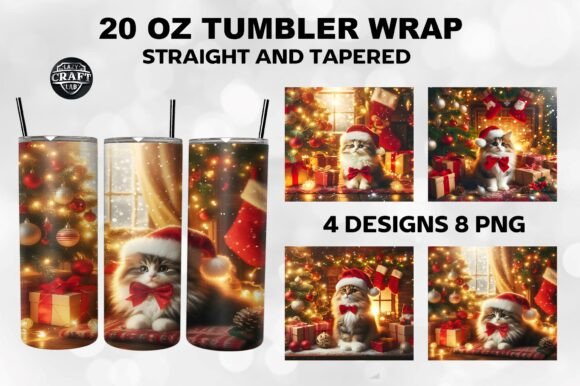
Christmas Cat 20oz Tumbler Wrap PNG
A Designer’s First Look: Cheerful, Compact, and Very “Skinny”
Opening the Christmas Cat 20oz Tumbler Wrap PNG feels like unboxing a holiday greeting card — warm, playful, and instantly festive. The design centers on a stylized cat wearing a tiny red-and-green scarf, perched beside a minimalist wreath and subtle snowflakes. It’s not overly detailed, but it’s intentional: clean lines, balanced negative space, and a vertical rhythm that fits snugly around a skinny tumbler’s curve. As an embroidery designer who regularly adapts sublimation graphics for stitch, my first thought wasn’t “cute!” — it was “how will this translate to thread?” Because while it’s built for sublimation printing, many of us — especially Etsy sellers and small shop owners — reach for designs like Christmas Cat 20oz Tumbler Wrap PNG to repurpose across handmade products: embroidered patches, tote bags, tea towels, baby onesies, or even holiday aprons.
Where This Design Truly Shines (and Where It Needs Care)
In real project use, Christmas Cat 20oz Tumbler Wrap PNG works beautifully when scaled up thoughtfully. I tested a mockup on a medium-weight cotton twill tote bag — resized to ~4.5” tall — and the cat’s face retained charm without losing clarity. The scarf’s folds and wreath’s circular shape translated well into satin stitch borders and soft fill stitch areas. For sweatshirt embroidery, it held up cleanly with light stabilizer, especially when paired with matte polyester thread for texture contrast. On baby onesies? Yes — but only if you simplify the inner wreath details first. Tiny loops and fine snowflakes don’t always survive dense stitching on lightweight knit fabric.
It’s less ideal for curved surfaces like caps unless you rework the layout. The original wrap format assumes a flat, vertical print surface — so direct hooping on a cap bill or baseball hat requires manual adjustment or digitizing support. Likewise, avoid using Christmas Cat 20oz Tumbler Wrap PNG as-is on stretchy fabrics (think jersey baby blankets or ribbed cuffs) without adding underlay stitches and testing tension. And on dark fabric? That subtle snowflake detail vanishes unless you add a white underlay or switch to a higher-contrast version in your embroidery software.
Real-World Use: A Holiday Gift Bundle in Progress
Last week, I used Christmas Cat 20oz Tumbler Wrap PNG as the anchor for a small-batch holiday gift set: embroidered kitchen towels, matching cotton napkins, and a single custom patch sewn onto a linen apron. I didn’t embroider the full wrap — instead, I isolated the cat + scarf motif, removed the background elements, and re-digitized it as a 3.2” applique design with raw-edge satin binding. Why? Because customers respond more strongly to clear focal points than busy wraps — especially on textured linens or tea towels where stitch definition matters. The result felt cohesive, handmade, and quietly professional. No one asked “What’s the tumbler for?” — they said, “I need four of these towels.” That’s the quiet power of smart adaptation.
Design Assets That Build Trust — Not Just Decor
For Etsy sellers and craft fair vendors, how a design reads at first glance affects buyer confidence. Christmas Cat 20oz Tumbler Wrap PNG reads as joyful but not childish, seasonal but not dated — a rare balance. When used well, it elevates a plain cotton sweatshirt from “generic holiday item” to “thoughtful personalized gift.” That perception shift directly impacts perceived value and repeat purchases. But it only works if the finished product looks intentional: consistent thread colors (I stuck with forest green, cranberry red, and cream), even stitch density, and no floating threads or jagged edges. Customers notice those things — especially when they’re paying for handmade quality.
Practical Embroidery Designer Notes Before You Stitch
- Always test first: Run a sample on scrap fabric matching your final product’s weight and stretch — especially for baby items or kitchen textiles.
- Check thread color contrast: The PNG is flat; embroidery adds dimension. Test your chosen thread palette on both light and dark fabric swatches before bulk production.
- Review stitch density: Sublimation files don’t include stitch data — you’ll need to digitize or source an embroidery file separately. Don’t assume low-density fills will behave the same as high-density ones on thin fabrics.
- Confirm hoop size compatibility: The original layout spans ~7–8” wide (typical for skinny tumblers). Resize carefully — shrinking too far risks losing legibility in small features like the cat’s eyes or wreath leaves.
- Inspect small details: Snowflakes and fine stems may need simplification or removal for reliable stitching on knits or terrycloth.
- Use proper stabilizer: Medium-cutaway for knits, tear-away for stable wovens, and fusible + tear-away for lightweight linens.
- Verify licensing: Since Christmas Cat 20oz Tumbler Wrap PNG is marketed as a sublimation graphic with instant download, confirm whether commercial embroidery use (e.g., selling embroidered patches or apparel) is permitted under its license terms — don’t assume.
Final Thought: A Flexible Asset — If You Treat It Like One
Christmas Cat 20oz Tumbler Wrap PNG isn’t a plug-and-stitch embroidery file — and that’s okay. Its strength lies in its mood, composition, and holiday warmth. Used as inspiration rather than instruction, it becomes a versatile starting point for custom apparel, boutique merchandise, or heartfelt personalized gifts. Whether you’re prepping for a craft fair, launching an Etsy holiday collection, or stitching a one-of-a-kind baby blanket, this design invites thoughtful reinterpretation. Just remember: great embroidery isn’t about copying pixels — it’s about honoring intention, respecting fabric, and letting the handmade quality shine through. That’s how Christmas Cat 20oz Tumbler Wrap PNG earns its place in your design assets — not as a shortcut, but as a spark.